
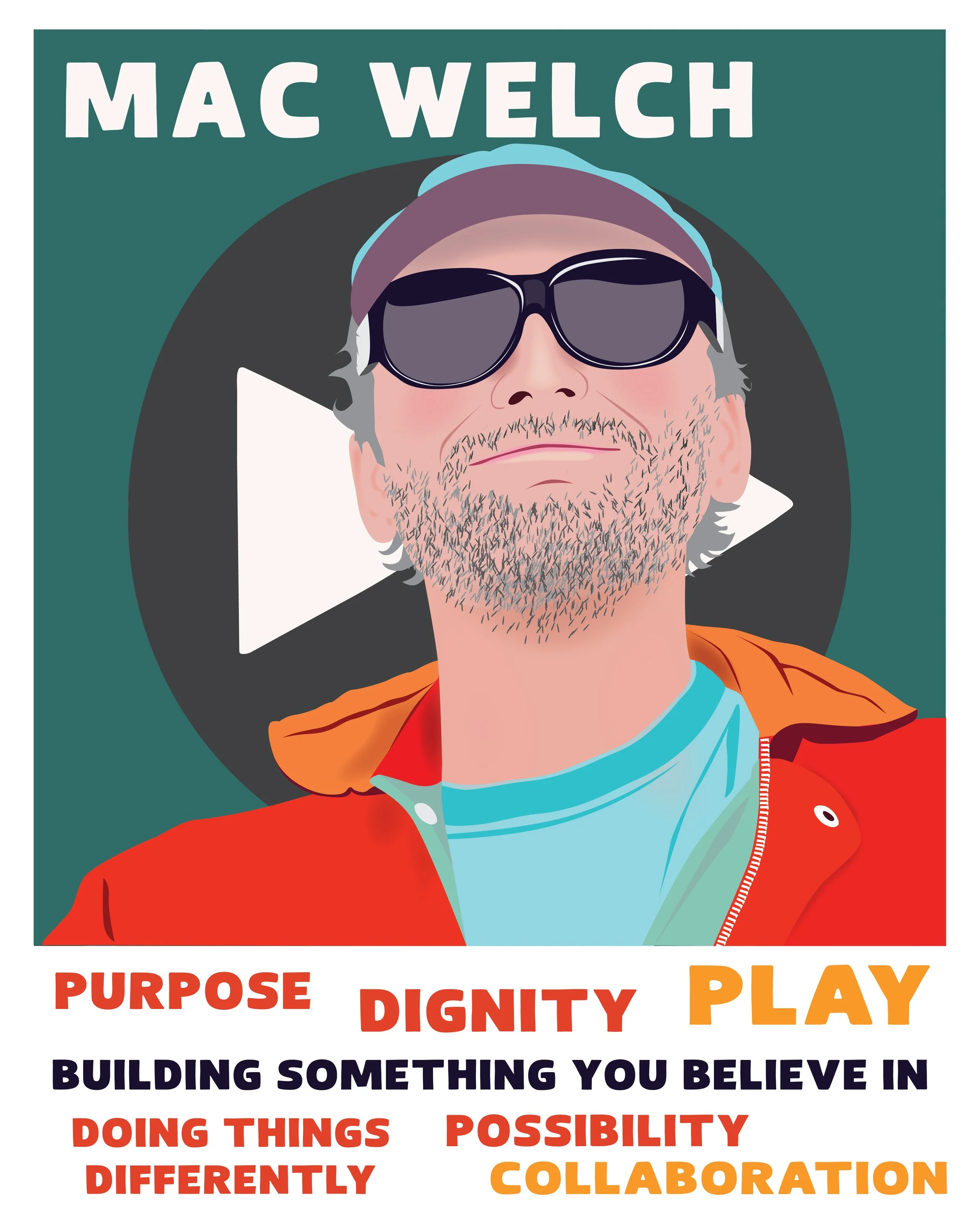
Fast Forward: Mac Welch
Giving Unfinished Music a New Life
What if the songs sitting on your hard drive could become something useful; for another musician, a cause you care about, or the wider creative community?
Mac Welch has spent much of his career helping other people make things happen: on the road as a tour manager, in artist management, and more recently at a music festival connected to free healthcare provision for artists.
Now he’s exploring a different way of working. His proposed non-profit, PROseed, would bring together musicians, people licensing music for films, TV and other stories, and organisations that artists want to support. Musicians would contribute songs and recordings, experiment with each other’s material, and potentially generate ongoing income for those organisations and a shared artist fund.
It’s still taking shape. There are questions around technology, ownership and how any income would be used. But at its heart is a refreshingly simple invitation: make music, have fun, and see what else it might make possible.
For our first Fast Forward conversation, we discussed his idea and his changing understanding of a sustainable life.
What are you trying to build?
I want to create a music commons: a sandbox for music creation and collaboration that can support non-profits artists believe in. The proposed organisation is called PROseed. It would own the contributed copyrights, with the longer-term ambition of contributors becoming stewards of the revenue generated by the recordings.
A central part of the idea is that a contribution could keep supporting your chosen organisation indefinitely, including through new music made from it. You’re contributing something that could keep doing good long after you’ve moved on to making something else.
The idea has been around in different forms for about 15 years. I love producing, experimenting and making sounds, but I have no interest in pursuing a career with it. That music sits on a hard drive and, without something like this, it will die silently.
Lots of people have material they enjoyed making but don’t want to market or perform. I want to find people willing to let it go and see what else could happen.
What have your experiences across the industry shown you about what people in music need?
At the core of it, I think people need dignity.
You’re there because of a specific passion that’s fulfilling. But there are moments when people are asked to spend their time on things that don’t connect with why they’re there. People work hard through it, but I think a lot of us are silently saying, “I’m actually an important part of this. I should be able to take pride in that.”
For musicians, there can be a point where they’re compromising what they make for their career’s sake. But they might still be having fun elsewhere. I want the library to be somewhere that work can go and do some good. Don’t let it die quietly on your hard drive.
Why connect music with long-term support for non-profits?
Working in the non-profit world made me think about how dependent organisations can be on funders’ priorities. A community might be asking for something clearly, but that doesn’t mean funding will follow.
Having an asset that can generate income over time could make a real difference. People donate property or land. I started asking: what would it look like to donate music rights, rather than make a one-off donation from a song’s profits?
The music industry has put enormous effort into turning music into financial assets. I’m interested in whether we can use those structures to support organisations and communities that artists care about.
Walk me through it. I have an unused recording — what would happen next?
You would upload a song and its stems — the separate audio parts — choose the band name and song title you want used in placements, and nominate a beneficiary organisation. You could contribute anonymously or under a project you’re actively promoting. Hate groups wouldn’t be eligible beneficiaries.
You would need to own the material and sign both the publishing and master copyrights over to PROseed outright. That’s a significant commitment, and it needs to be clear. The platform would then handle performing-rights organisation registration and organise the metadata.
You could browse, vote on tracks, download someone else’s stems, add your own music and upload the results with a beneficiary of your choice. Work made from library material would come back into the library, with the existing contributions’ beneficiaries remaining in the chain.
Your profile would show funds granted to organisations on your behalf and resources available through the master-side fund.
How would it work for someone wanting to license music?
The aim is a one-stop shop. Music supervisors and other storytellers could discover music through a library whose front page is influenced by artists’ votes.
Because PROseed would own both sets of rights, it could negotiate and clear licences without waiting for separate approvals. It would also retain the right to adapt compositions for a placement.
The model I’m exploring is a negotiated donation to PROseed, followed by a licence issued at no additional charge, the requested audio materials and donation documentation.
The goal is distinctive music, a straightforward clearance process and support for causes artists care about.
And what does the beneficiary organisation receive?
When an artist names an organisation, it would receive notification and a non-commercial licence to use the contributed audio to promote its own work.
The intention is that 100% of the publishing-side sync revenue allocated to your contribution goes to your chosen organisation, in perpetuity. Payments to organisations would be made quarterly, after funds have accrued interest.
If someone builds a new song using your contribution, your organisation stays in the chain of benefit. If that song gets sampled again within the library, the connection continues. Twenty-five years from now, a snare hit you contributed today could still be helping fund a cause you care about.
You can’t predict which piece of music will find a use, or what its future value might be. That possibility is part of what interests me: giving organisations access to a source of support that could keep generating income over time.
Where does the master-side fund fit in?
Income allocated to the recordings would support a shared fund. Ultimately, I’d like a large enough group of contributors to become stewards of that revenue.
Artist healthcare was the original starting point. Now I’m exploring how to make resources as accessible as possible while protecting PROseed’s intended non-profit status. How contributors could access money, and what restrictions would apply, still needs working out. I want more conversations with people who understand the available structures.
What kind of music belongs in the library?
I’m not asking for anyone’s babies. If you think a song belongs in your career or is something you want to build your artist project around, please keep it.
This is the sandbox. It’s where you put something you enjoyed making and are happy to let go of.
That might be a finished song or a drum loop. A guitar lick could become part of someone else’s track. Someone learning to mix could help another contributor’s recording sound better.
My brother is a public defender and still sends me songs. I’m here for career musicians, but also hobbyists.
What needs to happen next, and where could people help?
Software engineering and contributions are two areas where I’m looking for help. I’m teaching myself a lot to build the platform, and I’d love support from people with those technical skills.
I also want to sit down with people I know have hard drives full of music, hear what’s there and ask which organisations they’d like to support.
I’m looking for an established publishing partner who could help represent the library and safeguard its long-term purpose. Ideally, if PROseed couldn’t continue, that partner would keep the publishing operation running so the beneficiary organisations could still receive income.
The ownership side has to be done really well. I don’t want to do this alone. Collective thinking is part of the experiment.
What have you learnt about getting an idea out of your head and into the world?
That it’s okay to make it as fun for yourself as possible.
At the heart of this idea, I’m enabling myself to sit at a computer, listen to strangers’ music and experiment with whatever comes into my head. That’s what I would be doing if I had nothing else to do. It’s the most fun thing I know how to do.
I’m wholeheartedly the target audience. Every step towards the idea feels like building a community I’ve been missing.
You’ve talked about wanting a career that’s as sustainable as it is exciting. What does that mean to you now?
I think I’ve figured out the excitement. Stability is something I’m still working towards.
What I’m learning is that my stability can’t depend on one aspect of my life. It can come from family, friends, location and health, as well as work. There’s been a lot of taking measurements: what is stability? What feels comfortable to me?
For a long time, I approached it by adding things: “I’ll add this, and that will help.” Now I’m asking, “What happens if I take that away? What if I don’t need it?”
I’m proud that I’ve made progress with work while travelling and seeing people. Some things I used to consider absolute requirements for stability aren’t there, yet I feel good. I haven’t found all the stability I want, but I know what I’m looking for much better than I did before.
What’s one thing you’d like to see more people in music try?
Make music. Really.
If you’re in A&R, if you help budget projects, if you work in music and have never made a song, go and make one. It’s so much fun, and I think people either forget that or don’t understand how much work it takes.
Before saying, “You’ll just record that over the weekend,” try making something yourself.
And if it’s bad, give it to me.
Contact Mac: macwelch@gmail.com